
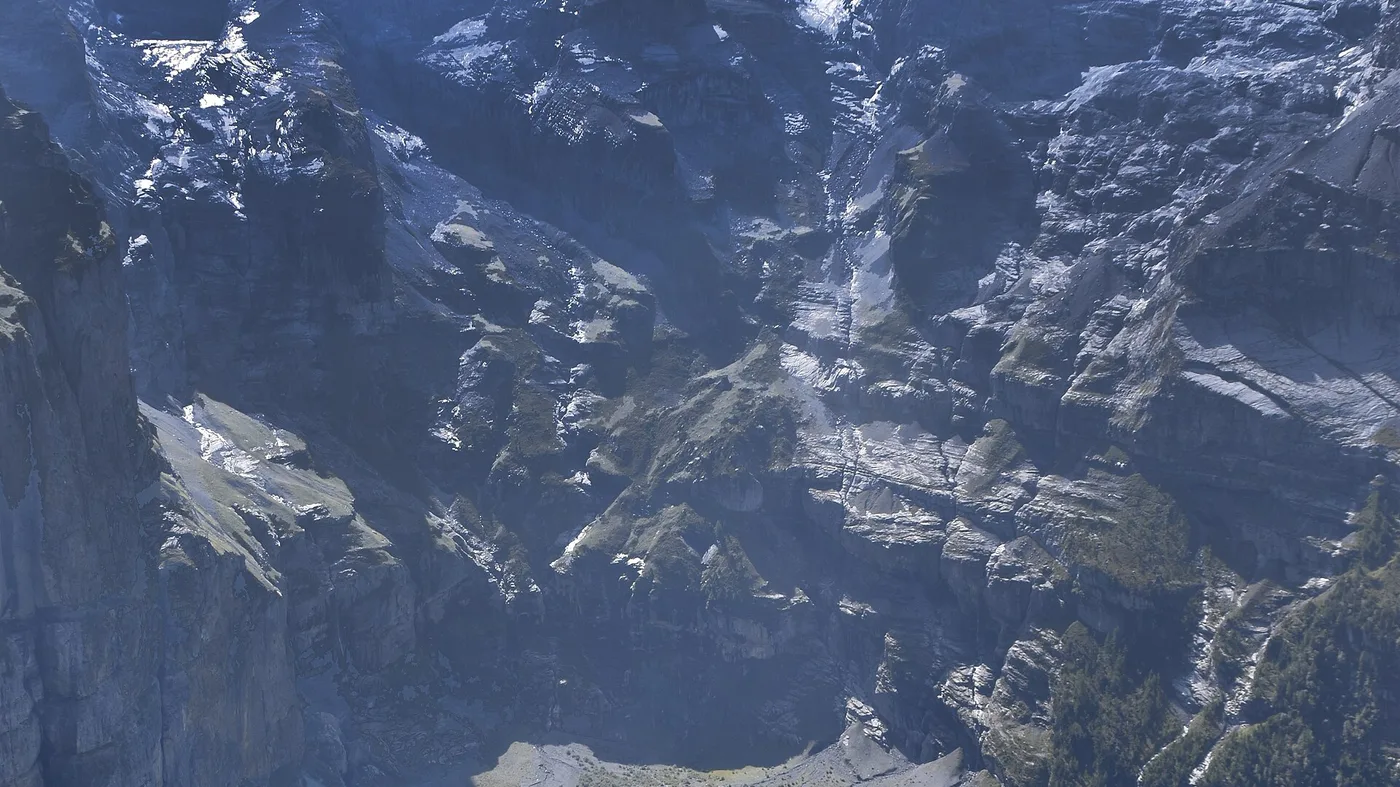
Kandersteg · UNESCO World Heritage area
Oeschinensee (Lake Oeschinen): How to Plan Your Visit
Last updated November 2026
Oeschinensee is a mountain lake above Kandersteg at about 1,578 m, below the Blüemlisalp. Take the gondola from Kandersteg, then walk the last stretch to the shore (about 20–30 minutes on the direct path). In the summer season the gondola ascent needs a time slot, so book the slot (and ideally a room) first.
Some booking links may earn us a commission at no extra cost to you. How this guide is funded →
Oeschinensee (Lake Oeschinen) sits above Kandersteg — a turquoise mountain lake reached by gondola, then a short walk to the shore. Most visitors come for that first view; the difference between a smooth day and a stressful one is usually the time slot, the trail, and whether you overnight nearby.
This guide covers the essentials: when to go, how the gondola works, which path to take, and why a night in the village often beats a rushed day trip. Dive deeper with the hike, gondola, getting there, day trip from Interlaken, hotels at the lake, best time, winter and activities pages. For village beds, use where to stay.
Quick facts
- Altitude
- About 1,578 m (confirm)
- Area
- About 1.1 km²
- Max depth
- 56 m
- Formed by
- Prehistoric landslides
- Heritage
- Swiss Alps Jungfrau-Aletsch UNESCO area (since 2007)
- Access
- Gondola from Kandersteg + walk (or hike from the valley)
- Booking tip
- Reserve the summer gondola ascent slot before you travel
Published figures commonly give about 1,578 m elevation, about 1.115 km² surface area and a maximum depth of 56 m, with formation attributed to prehistoric landslides (cross-check altitude on MySwitzerland and note that some trip pages cite 1,575 m). The lake sits in the Swiss Alps Jungfrau-Aletsch UNESCO World Heritage area (listed since 2007). Access is by gondola plus a shore walk for most visitors; summer and winter both have operating seasons with a spring gap — confirm the current calendar on oeschinensee.ch.
Is Oeschinensee worth it?
Yes, if you want one of the Bernese Oberland’s clearest “lake under big walls” days and you are willing to plan the slot, the walk and the crowds. The scenery earns the search volume that sits behind this domain. What hurts the day is logistics: summer ascents need a reservation, parking fills, and midday trains dump groups at once. Social posts and ticket widgets that rank today rarely explain those constraints — that is the gap this guide is written to fill.
Go if Oeschinensee is a highlight of your Swiss trip, you can hold a morning or late slot, or you will stay in Kandersteg and start early. Families with buggies can use the direct path when the operator marks conditions suitable; hikers who want more than a shore photo should budget the panorama or mountain letters instead of only trail C.
Skip or shorten if you only have a tight half day with no buffer, you refuse to book ahead in summer, or you want a quiet empty shore in July at noon — that combination rarely exists. Crowds are real in peak months; early and late light is usually calmer (advice, not a guarantee). If your whole itinerary is already packed with other Oberland highlights and you dislike shared gondolas, a different valley day may fit you better.
Pairing with Blausee on a second day is a common extension once the lake day is secure. If you are still choosing a base, return to the Kandersteg hub for the overnight vs Interlaken day-trip framing, then lock where to stay before peak weekends.
How to get there
From Kandersteg station you reach the gondola valley station on foot or, in season, by local bus timed to trains; then ride the gondola and walk to the shore. Travellers from Interlaken, Bern, Zurich or Lucerne should think in three hops — mainline train into Kandersteg, last mile to the valley station, then gondola and path — not as a single “ticket to the lake” product unless you buy a guided tour that explicitly bundles them.
Full city-by-city options, parking notes and “from Zurich / Bern / Lucerne” variants live on getting to Oeschinensee. Tickets, hours, Half Fare behaviour and the reservation flow are on the gondola guide.
| Leg | What to expect | Detail |
|---|---|---|
| Kandersteg station → valley station | Footpath or seasonal bus | Footpath about 15 minutes; local bus often runs June–October for every train (also noted on the winter FAQ pages) |
| Valley station → top station | Gondola | Summer ascents need a time slot — see gondola page |
| Top station → lake | Walk (or seasonal taxi) | Direct path about 20–30 minutes; taxi may run for a fee |
Always recheck SBB for trains and the official lake site for bus and gondola status the same morning. If you are driving, treat parking as a scarce resource and have a train fallback; do not plan to cycle the closed access road.
Which path to the lake?
Official trail letters matter more than blog nicknames. Times below follow the operator’s English material; trail C is described both as “in 20 minutes” and “approx. 30′”, so we write a range. If you only remember one thing: C gets you to the water quickly; D and G are the reason hikers linger; A is the no-gondola climb.
Full maps, difficulty, rockfall notes and winter status: Oeschinensee hike. For a guided panorama option from the village tourist centre, see the tour cards near the end of this page.
| Trail | Route idea | Typical time | Notes |
|---|---|---|---|
| C | “Direttissima” top station → lake | About 20–30 min | Direct path; operator notes buggy-suitable conditions when open |
| D | Panorama via Läger | About 40 min | Wider views; still a walk, not a via ferrata |
| A | Lower station → lake | About 90 min | Full hike up without relying on the gondola |
| K | Lakeshore circuit segment | About 10 min | Short shore walking near the water |
| G | Läger–Heuberg–Oberbärgli | About 1 h 30 | Mountain trail; weather and fitness required |
| B | Huble | — | Listed as a construction-zone closure at the time of checking — confirm live status |
We never call a path “safe”. Rockfall and works change what is open; read the status box below before you commit. If Heuberg or Oberbärgli segments are closed, do not invent a bypass from a screenshot — wait for the operator update or choose a lakeshore day instead.
Gondola time slots, discounts and tickets
In the summer season, a time-slot reservation is compulsory for gondola ascents. Tickets bought via SBB Mobile or Swiss Activities do not replace that slot — the official FAQ explains why a third-party ticket alone is not enough. Book the slot first, then travel. This is the single rule that turns a casual “we’ll wing it from Interlaken” plan into a wasted transfer.
Discounts (percentages, not cash fares): Half Fare Card, GA and Swiss Travel Pass holders get 50% on the gondola (not via ski day passes); children under 6 ride free per the operator’s published rules (including winter pages). Guest-card and MagicBlue-style stay benefits are described on destination pages — confirm what your overnight includes on kandersteg.ch before you assume a discount at the kiosk. Always check the current tariff table on the official site.
Parking: spaces at the valley station (P1–P3) are limited and may be gone from about 11:00; vehicles over 5 m long or 2 m high cannot park there. Public transport into Kandersteg is the less stressful default. Camper and long-vehicle drivers should read the official parking notes twice. More detail: Oeschinensee gondola.
Day trip or stay the night?
A day trip from Interlaken works when trains and slots align; it fails when the ascent is fully booked or parking is gone. Many US and UK itineraries treat Oeschinensee as a checkbox from Interlaken — that can work, but only if the gondola reservation exists before you leave the hotel breakfast queue.
Staying in Kandersteg buys an early start, guest-card transport perks when overnight stays qualify, and a second activity day (2 days in Kandersteg). Compare explicitly on day trip from Interlaken. Sleep near the water on hotels at the lake, or pick a village base on where to stay — book the bed first in July and August, then the slot, then the trail.
What to do at the lake
Once you reach the shore, the classic extras are seasonal rowing boats, a cold swim, the mountain coaster in summer, fishing where permitted, and the restaurants by the water. Swimming answers the autocomplete question quickly: yes, people swim, and the water stays cold — plan a short dip, not a long session, and follow local rules about where you enter.
None of these extras replace checking opening windows on the operator site. Practical detail and “is it running?” links: Oeschinensee activities.
An electric taxi may operate from the top station toward the lake in season, with priority for reduced mobility (secondary trip pages describe the same service — confirm fare and hours officially; we do not quote prices). If mobility is limited, ask about the taxi and path surface on the morning you travel rather than assuming trail C will suit every buggy or wheelchair.
When to go
Summer brings boats, busy trails and mandatory ascent slots — peak search interest tracks July and August, so plan earlier than you think. Shoulder months trade crowds for colder water and shorter hours; “is Oeschinensee open?” depends on the operating calendar, not on Instagram snowmelt photos. Winter shifts to ice-related visits and winter operations when the season is open, with a typical spring gap between seasons.
Month-by-month planning: best time to visit Oeschinensee. Ice walk, ice fishing and Oeschiland notes: Oeschinensee in winter. Pair either season with the weather / conditions checklist before you leave the hotel. We do not declare ice walkable; only the operator and local rules decide that on the day.
Rules that catch people out
These are the policies travellers miss most often — verify each on the official FAQ before you pack. Ignoring them can end a trip with a fine, a refused boarding, or a confiscated drone, none of which appear in glossy lake photos.
- Wild camping is prohibited in the whole municipality; camping, bivouacking and hammocks at Oeschinensee are prohibited by court order
- Drones and commercial events are prohibited
- Fires only at official barbecue sites
- Secondary sources state the access road is closed to motor traffic and to bikes/e-bikes, and that the gondola does not carry bikes, scooters or SUPs
- Dogs need a valid ticket (confirm the current animal rules on the operator site)
If you hoped to SUP, e-bike the access road, or sleep in a hammock above the shore, redesign the day around the rules above rather than around a viral reel.
Rockfall and trail closures
Instability at the Spitzen Stein has led to sector and trail closures in recent years (reporting summarised via Swissinfo references on Wikipedia). Trail B has also appeared as a construction closure. Treat every blog trail list as stale until you open the official status page the day you hike. When a sector is closed, choose another letter or another valley day — do not scramble past barriers for a photo.
Prefer a guided day?
If you want trains, gondola timing and guiding bundled — especially from Interlaken — curated GetYourGuide options include:

Photo: GetYourGuide
Day trip
From Interlaken: Oeschinen Lake Scenic Hiking Tour
- Train Interlaken–Kandersteg return
- Round-trip gondola
- Guaranteed gondola departure
- Swiss tour guide
Listing checked November 2026
Photo: GetYourGuide
From Interlaken
Interlaken: Day Tour to Oeschinensee with Cable Car
- Small group (max 8)
- Hotel pickup in the Interlaken area
- Cable car included
Listing checked November 2026

Photo: GetYourGuide
Village favourite
Kandersteg: Oeschinensee Panorama Hike with a Swiss Athlete
- Private guided panorama hike
- Gondola optional at extra cost
Listing checked November 2026
For a self-planned overnight with a second valley stop, keep Blausee and the 2-day itinerary in the mix, and book beds via where to stay early.
Map — places to stay near the lake
Coordinates below follow commonly cited lake positions (Wikipedia); confirm against your map app before navigation. The Stay22 map is for browsing beds — most visitors sleep in Kandersteg village, not on the shore.
Map centred on this area. Browse nearby places to stay.
Looking for places to stay in Kandersteg? Start with the where to stay shortlist, then reserve the gondola slot.
Oeschinensee silo — child guides
Keep this hub open while you plan; then open the child page that matches your bottleneck:
Your questions, answered
Is Oeschinensee worth visiting?
Yes for most first-time Bernese Oberland travellers who want a high turquoise lake with a clear logistics plan. It is less worth it if you refuse to book a summer gondola slot, hate crowds, or only have a half day with no buffer for trains and queues.
Do you need to book the Oeschinensee gondola?
In the summer season, ascents need a time-slot reservation. A ticket alone from some third-party channels is not enough without that slot. Check the current rule on the official Oeschinensee site before you travel.
How long is the walk from the gondola to the lake?
The direct path (trail C) is about 20–30 minutes from the top station to the shore. Panorama and mountain options take longer. An electric taxi may run in season for a fee, with priority for reduced mobility.
Can you swim in Oeschinensee?
Swimming is possible in season, but the water is cold mountain water. Treat it as a short dip, not a beach holiday. See the activities guide for seasonal notes and always follow local rules.
Can you hike to Oeschinensee without the cable car?
Yes. Trail A from the valley is about 90 minutes up. It is a real climb; bring time, fitness and weather buffer. Most visitors still use the gondola for at least one direction.
Is Oeschinensee open in winter?
The area has a winter season with different services (including ice-related activities when conditions and operators allow). There is typically a spring gap between winter and summer operations. Confirm dates and rules on the official site.
Can you visit Oeschinensee as a day trip from Interlaken?
Yes. Trains connect Interlaken and Kandersteg, and some tours include a guaranteed gondola departure. Compare day trip vs overnight before you lock tickets — summer slots and parking fill early.
Is Oeschinensee a glacial lake?
It is often described as formed by prehistoric landslides and fed by mountain streams rather than as a classic “glacier-scooped” basin. Check the wording you need against scientific and tourism sources linked below.